Plugged In @ Hinman Straub
January 23, 2026

What’s Inside
- FY 2027 Executive Budget Recap
- Joint Budget Hearing Schedule
- Legislative Session Review
- New York’s Congressional Map to be Redrawn
- In the News
- Coming Up
FY 2026-27 Executive Budget Recap
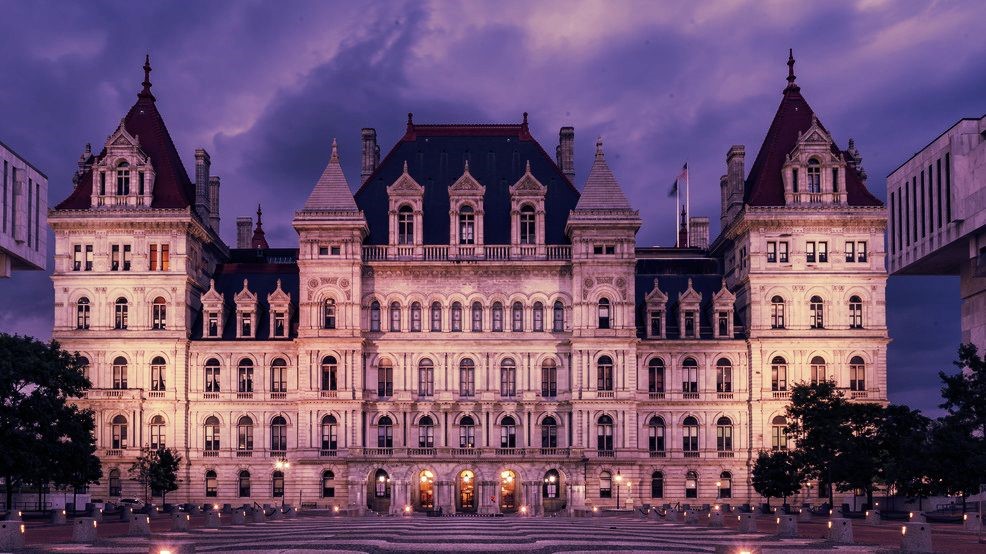
Governor Kathy Hochul delivered her FY 2026-27 Executive Budget address on Tuesday, January 20, 2025, in the “Red Room” at the State Capitol in Albany. Her Executive Budget proposal is estimated to drive all governmental funds spending to $260 billion, a $1.6 billion increase (0.7%) over FY 2026 to offset federal cuts, especially in healthcare.
An update to the economic outlook reflects tax receipts growth, resulting in a General Fund surplus of approximately $3.8 billion in FY 2026. The budget plan includes several actions to reduce out-year budget gaps to $6 billion in FY 2028, $9 billion in FY 2029, and $12.5 billion in FY 2030. The budget maintains principal reserves, which are comprised of discretionary reserves and the statutory Rainy-Day Reserves, now totaling $14.6 billion. It includes $4.5 billion for child care, $1.3 billion for universal pre-K, and $30 million for farmer relief. The state’s reserves are projected to reach $10 billion by 2028. Despite federal cuts, New York’s revenue exceeds projections by $17 billion over two years, supporting investments in infrastructure, education, and social services.
The Governor’s budget proposal includes initiatives unveiled in her State of the State address on January 13. In her remarks announcing the Executive Budget proposal, she stated her priorities are to protect core services without raising income taxes, focusing on affordability through increasing access to child care, early education, and meal assistance programs, as well as through affordable housing. The Governor also prioritized public safety as well as environmental and clean water investments.
The Governor’s briefing book can be found here. The Governor’s budget briefing can be watched here, and Budget Director Blake Washington’s budget briefing can be watched here. Highlights of the 2027 Executive Budget proposal include:
Affordability. Governor Hochul continued her “Affordability Agenda,” aiming to east the cost burdens on New Yorkers. These include:
- The FY 2027 Executive Budget eliminates New York State income tax on tipped wages – up to $25,000 per year – for single filers earning up to $150,000 and joint filers earning up to $300,000.
- Increases income eligibility limits for SCRIE and DRIE from $50,000 to $75,000 in New York City, with the same options being available at local-opt in outside the City.
- $395 million to reimburse the cost of school meals served in SY 2027, a $55 million (16.2 percent) year-to-year increase to continue implementation of the Universal Free School Meals (UFSM) program that was enacted in the FY 2026 Budget.
$561 million (52.5 percent) increase to Universal Prekindergarten Aid in SY 2027, including anticipated additional aid to school districts expanding their programs to serve more four-year-olds.
Child Care and Early Child Care Education. The Governor highlighted one of the first steps toward her affordability agenda included child care affordability. The Executive Budget includes:
- $4.5 billion across child care and Pre-K programs.
- Additional $1.23 billion to bolster CCAP
- $73 million to begin a contract-based child care program for two-year olds in NYC (NYC 2-Care).
- $1.5 million for the creation of the Office of Child Care and Early Education.
Education. The Executive Budget includes new investments for education and to support children with programs like Universal Pre-K for Four-Year-Olds by SY 2029. Also, the Budget includes:
- $39.3 billion in school aide for school year 2027, an increase of $1.6 billion (4.3 percent), inclusive of a $779 million (3.0 percent) Foundation Aid increase. This growth fully funds the current formula and ensures that each school district receives at least a 1 percent year to-year increase, bringing Foundation Aid to a total of $27.1 billion for SY 2027.
- $9.4 to higher education
- $2 million to the New York State United Teachers (NYSUT) Education and Learning Trust to deliver training to educators on instructional best practices for numeracy and evidence-based math instruction.
- $2 million for regional hub pilots operated by boards of cooperative educational services (BOCES) to provide training and support to educators in school districts with low levels of math performance.
- $395 million to reimburse the cost of school meals served in SY 2027, a $55 million (16.2 percent) year-to-year increase to continue implementation of the Universal Free School Meals (UFSM) program that was enacted in the FY 2026 Budget.
- $12.5 million to expand the New York State Opportunity Promise Scholarship program to additional high-demand fields and to students with prior degrees pursuing a nursing degree, as well as $500,000 to introduce the Reconnect for Foster Scholars program.
Public Safety. The Governor proposes new spending to support violence prevention and public safety increases through proposals including:
- $8.25 billion in spending in FY 2027 for New York State’s public safety agencies.
- $352 million for programs to prevent and reduce gun violence in our communities.
- $2 million for the State Police to investigate and build criminal cases against auto insurance scammers and fraudsters. The Executive Budget also includes legislation to fight back against criminal fraudsters by establishing criminal penalties for staged accidents.
- $305 million to ensure a fairer New York by improving the effectiveness of the criminal justice system, including prosecution, defense services, pretrial services, discovery reform implementation and reentry services.
- $35 million for the next round of the Securing Communities Against Hate Crimes (SCAHC) program.
- Another $77 million investment to partner with New York City to increase police presence on platforms and trains by temporarily surging patrol levels.
- $50 million for the Law Enforcement Technology (LETECH) grants, supporting Law enforcement agencies statewide in acquiring critical technologies and equipment to enhance crime prevention and community engagement.
- $5 million in funding for the State Police to pilot drones as first responders. $400 million in funding to accelerate and install fixed cameras in all facilities, $18 million for the body-worn camera program, and $7.2 million to expand and restructure the Office of Special Investigations (OSI).
- $35 million for the Securing Communities Against Hate Crimes program
- $150 million to complete construction of a Statewide Emergency Operations Center.
Housing. Governor Hochul proposes lowering the cost of housing and making a home more obtainable for people across the income spectrum in various wasy, including the following funding proposals:
- $25 billion over five years to support housing plan to create and preserve 100,000 affordable homes, including 10,000 homes with support services for vulnerable populations.
- continues support for a $1 billion State contribution to “City of Yes for Housing Opportunity” program.
- $250 million to accelerate new construction of affordable housing units.
- $760.5 million in discretionary funding available for Pro-Housing Communities.
- $250 million to accelerate new construction of affordable housing units
- $75 million for first-time homebuyers, including $50 million in capital for starter homes and $50 million for down payment assistance.
- $50 million to support development of mixed-income rental housing outside New York City, Mixed-Income Revolving Loan Fund.
- $500 million to facilitate the conversion of State-owned land into as many as 15,000 units of housing.
- $50 million in new local assistance consistent with the four-year Housing Access Voucher Pilot Program designed to provide rental assistance in the form of housing vouchers for individuals and families who are homeless or who face an imminent loss of housing.
Economic Development. Citing statistics that New York has recovered from job losses during the pandemic, the Governor advanced proposals to spur continued economic growth, including:
- $750 million to continue economic development programs and support for rural communities, including $400 million for the NY Works Economic Development Fund, $200 million for the Downtown Revitalization Initiative and NY Forward funding, and $150 million for the Regional Economic Development Council (REDC) program
- $225 million for economic development projects in the City of Rochester.
- $300 million for the second year of investment in “power-ready” sites for advanced manufacturing and other development.
- $47 million to fund free community college for New Yorkers aged 25-55 pursuing high-demand degrees, such as nursing, technology and engineering.
- $100 million for another round of the Downtown Revitalization Initiative (DRI), which has been transforming downtown neighborhoods into vibrant communities where the next generation of New Yorkers will want to live, work, and raise families.
- $85 million to develop a semiconductor chip design center and four new quantum technology commercialization hubs across the State.
Mental Health. The Executive Budget includes spending for mental health programs and professionals including:
- $15 million to expand independent living opportunities for individuals with I/DD.
- $17.5 million to expand the Teen Mental Health First Aid training to be available to all tenth graders in New York State.
- The FY 2027 Executive Budget provides funding to establish a Gambling Addiction Workforce Institute, integrate gambling peer and supportive services into recovery and outreach centers, and conduct a 10-year study to assess trends in the impact of gambling.
- Additional $53.5 million in State funds to support minimum wage increases for staff at programs licensed, certified, or otherwise authorized by OPWDD, OMH, and OASAS.
Environment and Climate Investment. The Governor is proposing new spending to support the transition to clean energy sources, for water and wastewater infrastructure, and for climate resiliency, including:
- $2.1 billion over five-years, equivalent to $425 million per year. This funding goes toward forest and farmland protection, local parks, water quality, and other environmental initiatives
- $3.75 billion – $750 million per year for five years – in clean water infrastructure funding.
- $668 million is appropriated for the support of United States Army Corp of Engineers (USACE) projects,
- $5 million appropriation for NYSERDA’s new Mechanical Insulation Energy Savings Program, which provides grants to public housing, public hospitals, and school districts for mechanical insulation, which will increase the energy efficiency of their heating and cooling systems.
- $50 million for the improvement of the Canal System. These funds will be used for dam and lock repair, flood mitigation, infrastructure improvements, canal system resiliency, and other projects that will improve the overall canal system.
Agriculture. The Governor proposes assistance for farmers, including:
- $30 million in direct payments to New York’s specialty crop growers, livestock producers, and dairy farmers to help support New York’s agricultural sector and offset rising costs caused by tariffs.
Health Care. Governor Hochul proposes new investments in healthcare, including:
- $38.2 billion for the Medicaid program. Current projections indicate over 6.8 million enrollees by March 2026.
- $1.33 billion to support “safety net” hospitals serving at-risk New Yorkers.
- $694 million for workforce development programs supporting health, behavioral health and social care workers.
- $1.3 billion in new capital funding for SUNY and CUNY systems, including $900 million to maintain and preserve campus facilities, including $150 million for SUNY hospitals
- $150 million for SUNY hospitals
- $35.8 million in capital funding to support the development and implementation of an electronic health records system for the incarcerated population.
Under New York’s budget-making process, the Governor has developed and proposed to the Legislature a comprehensive and balanced budget proposal – the FY 2027 Executive Budget proposal issued January 20. What’s next? The Governor has up to 30 days to amend her budget proposal.
Over the next several weeks, the Assembly and Senate will conduct joint legislative budget hearings on this proposal, by agency and issue area, and negotiations with the Governor usually commence thereafter. These hearings will begin shortly.
The 2007 Budget Reform Act mandates the use of conference committees as part of the legislative budget process. These committees work to facilitate agreement on a budget plan between the two houses. The Assembly and Senate develop joint recommendations, amend the Governor’s proposed bills to reflect their priorities, and pass the amended bills. If the Governor does not agree with the Legislature’s changes to her proposal, she may exercise her veto authority.
The FY 2027 budget year begins April 1, 2026.
Joint Budget Hearing Schedule
Following the Governor’s release of the FY 2027 Executive Budget legislation, the New York State Legislature issued its joint legislative budget hearing schedule. These hearings, each of which focuses on a programmatic area of the Executive Budget Proposal, are intended to provide the appropriate legislative committees with public input. The hearings will be available for viewing on the Senate and Assembly websites.
Budget hearings will commence on Tuesday, January 27, and conclude on Thursday, February 26. The respective state agency or department heads will begin testimony each day, followed by witnesses who have requested to testify on that area of the budget.
Please note that requests to testify must be made by submitting a Hearing Request Form.
The joint budget hearing schedule is as follows:
- Agriculture & Markets/Parks & Recreation: Tuesday, January 27 at 9:30 a.m.
- Environmental Conservation/Energy: Wednesday, January 28 at 9:30 a.m.
- Elementary Education/Secondary Education: Thursday, January 29 at 9:30 a.m.
- Transportation: Tuesday, February 3 at 9:30 a.m.
- Mental Hygiene: Wednesday, February 4 at 9:30 a.m.
- Human Services: Thursday, February 5 at 9:30 a.m.
- Health/Medicaid: Tuesday, February 10 at 9:30 a.m.
- Local Government/General Government: Wednesday, February 11 at 9:30 a.m.
- Public Protection: Thursday, February 12 at 9:30 a.m.
- Higher Education: Tuesday, February 24 at 9:30 a.m.
- Labor/Workforce Development: Wednesday, February 25 at 9:30 a.m.
- Housing: Wednesday, February 25 at 2:00 p.m.
- Economic Development/Arts: Thursday, February 26 at 9:30 a.m.
- Taxes: Thursday, February 26 at 2:00 p.m.
Legislative Session Review
The Legislature convened for session on Tuesday and Wednesday this week. Due to projected weather conditions, session has been cancelled for Monday, January 26, but will be convened on Tuesday and Wednesday next week. However, next week’s calendar is subject to change.
This week, Assembly Speaker Carl Heastie announced that he has appointed Alana Sivin to serve as counsel to the Speaker of the New York State Assembly. Sivin most recently served as director of the Greater Justice New York Initiative at the Vera Institute of Justice. Prior to that she was New York State director for criminal justice reform at FWD.us.
Speaker Heastie said:
More information can be found here.
New York’s Congressional Map to be Redrawn
|
On Wednesday, Judge Jeffrey Pearlman, an acting Supreme Court justice in New York County, ordered that New York must redraw its congressional map by early February and cease using its current map, ruling that the state’s current 11th Congressional District violates the New York State Constitution and dilutes the votes of Black and Latino voters. The 11th District, which includes parts of New York City, including the entirety of Staten Island, is currently represented by Republican Rep. Nicole Malliotakis. The court’s decision could significantly reshape New York’s political landscape ahead of the 2026 elections. State lawmakers must now craft a new map by early February. Read a news report on the issue here. Following this ruling, Governor Hochul issued the following statement:
|
In The News
City & State NY’s weekly Winners and Losers of this week here.
Simmering tax hike debate thickens between Hochul and Mamdani.
After Mamdani reversal, Gov. Hochul proposes 4-year extension of mayoral control over NYC schools.
Nurses’ strike enter second week, with no end in sight.
She’s a billionaire. He’s a socialist. Can they get along?
Kathy Hochul pushes to tax Zyn, other nicotine products like cigarettes— but critics are fuming.
Bipartisan support boosts 9/11 health program funding prospects.
New York extends nuclear subsidies until mid-century.
Stat Comptroller demands Uber release report on sexual misconduct incidents in shareholder proposal.
Lawmakers skeptical of Hochul’s claimed $1.2B in home care savings.
Rep. Malliotakis responds to judge order to redraw her district.
Governor Hochul proposes funding for farmers.
In election year, Gov. Kathy Hochul’s budget plan steers clear of controversy.
Democratic primary for local congressional seat is taking shape.
Regulators extend payments to New York’s nuclear fleet.
Coming Up
The Board of Regents will hold their next meeting on February 9 and 10.
The joint budget hearing schedule is as follows:
- Agriculture & Markets/Parks & Recreation: Tuesday, January 27 at 9:30 a.m.
- Environmental Conservation/Energy: Wednesday, January 28 at 9:30 a.m.
- Elementary Education/Secondary Education: Thursday, January 29 at 9:30 a.m.
- Transportation: Tuesday, February 3 at 9:30 a.m.
- Mental Hygiene: Wednesday, February 4 at 9:30 a.m.
- Human Services: Thursday, February 5 at 9:30 a.m.
- Health/Medicaid: Tuesday, February 10 at 9:30 a.m.
- Local Government/General Government: Wednesday, February 11 at 9:30 a.m.
- Public Protection: Thursday, February 12 at 9:30 a.m.
- Higher Education: Tuesday, February 24 at 9:30 a.m.
- Labor/Workforce Development: Wednesday, February 25 at 9:30 a.m.
- Housing: Wednesday, February 25 at 2:00 p.m.
- Economic Development/Arts: Thursday, February 26 at 9:30 a.m.
- Taxes: Thursday, February 26 at 2:00 p.m.